

Shape the Future of Learning: Meet PeopleLink at GESS Saudi Arabia 2025!
- May 20, 2025
- Posted by: Mayank Ashar
- Categories: Event, Industries
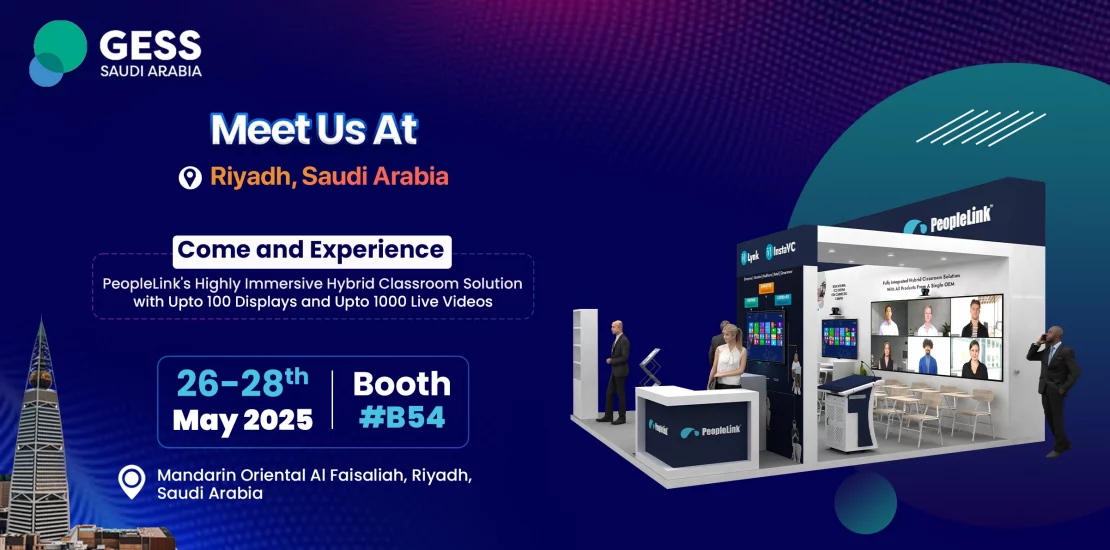
At GESS Saudi Arabia 2025, held at the Mandarin Oriental Al Faisaliah in Riyadh from 26 to 28 May 2025, PeopleLink presented its Highly Immersive Hybrid Classroom Solution at Booth B54. GESS is one of the region’s leading education events, bringing together educators, decision-makers, and technology suppliers from across the Kingdom and the wider region.
The solution PeopleLink showed reflects where classrooms are heading: spaces where students in the room and students joining remotely share one engaging experience, delivered as a single integrated system rather than a shelf of separate devices.
What a Highly Immersive Hybrid Classroom Includes
The build PeopleLink presented brings several elements together as one platform. A 4K Android-based interactive flat panel makes lessons dynamic and collaborative. AI-powered PTZ tracking cameras follow the lecturer and students automatically, so remote learners always see who is speaking. An all-in-one digital podium gives the educator control of the room from one station. Ceiling microphones and speakers with integrated DSP keep audio clear across the whole space.
These work with leading video conferencing and learning-management systems for virtual and hybrid delivery. As a single global OEM that designs, assembles and manufactures the full stack, PeopleLink tunes the parts to work together, which is what makes a hybrid room feel like one experience rather than a set of gadgets.
Why Hybrid Classrooms Matter for Modern Institutions
A hybrid classroom only works if the remote learner is not a second-class participant. Tracking cameras, room-wide audio, and a bright shared display are what give students at a distance the same view and the same voice as students in the room. The payoff is engagement: learners stay involved instead of drifting away from a fixed, distant camera shot.
For institutions in fast-growing education markets, this also future-proofs the room. A space built for hybrid from the start can run in-person, remote, and recorded modes without a separate setup for each.
Built for Large-Scale, Immersive Learning Environments
The same approach scales from a single classroom to auditoriums and multi-room facilities. Standardising on one design and repeating it keeps the experience consistent across a campus and keeps support straightforward. PeopleLink’s virtual classroom solutions and education solutions are built around this kind of phased, repeatable rollout.
That is what lets an institution start with a flagship room and grow into a campus-wide standard without re-specifying the technology every time.
One Global OEM for the Whole Room
When the panel, the cameras, the audio, the podium, and the software all come from one OEM, the institution has a single point of accountability and a platform that is updated as one. There is one support path when something needs attention, rather than several vendors to coordinate while a class waits.
That is the practical advantage behind an immersive hybrid classroom: not just the technology in the room, but the fact that one company stands behind all of it.
Questions to Ask Before You Build a Hybrid Classroom
Three questions decide most hybrid-classroom projects. First, what is the largest room, and will the camera and audio actually cover it? A solution sized for a seminar room will not serve a 200-seat hall. Second, will remote learners genuinely have parity, or will they be watching a fixed, distant shot? Tracking cameras and room-wide audio are what close that gap. Third, how many rooms will follow this one? If the answer is more than a few, a repeatable standard build matters more than any single feature.
The fourth question is who stands behind the room when something breaks. A single global OEM means one support path and one platform to update, instead of several vendors to coordinate while a class waits. Working through these questions early is what separates a flagship demo room from a design an institution can roll out with confidence. PeopleLink’s education solutions are built for that kind of scale.
Frequently Asked Questions
What is a hybrid classroom?
A hybrid classroom teaches students in the room and students joining remotely in the same live session, with equal audio, video, and content for both. The aim is parity, so remote learners can see, hear, and take part as well as those present.
What makes a hybrid classroom immersive?
Tracking cameras that follow the lecturer and students, room-wide audio with clear sound, a large interactive display, and integrated software together make remote learners feel part of the class rather than watching from a distance.
What equipment does a hybrid classroom need?
An interactive flat panel, AI tracking cameras, ceiling microphones and speakers, a digital podium, and software that works with video conferencing and learning-management systems. PeopleLink supplies these as a single, tuned system.
Can a hybrid classroom scale across a campus?
Yes. A standard room design can be repeated across classrooms, auditoriums, and multiple campuses, which keeps the experience consistent and support simple. PeopleLink supports this phased rollout as a single OEM.
Ready to talk to PeopleLink?
See PeopleLink’s AV and Unified Communications solutions in action, or get pricing built around your needs.