

- November 24, 2026
- Posted by: Abhishek Pratap Singh
- Categories: Blogs, Meeting Rooms
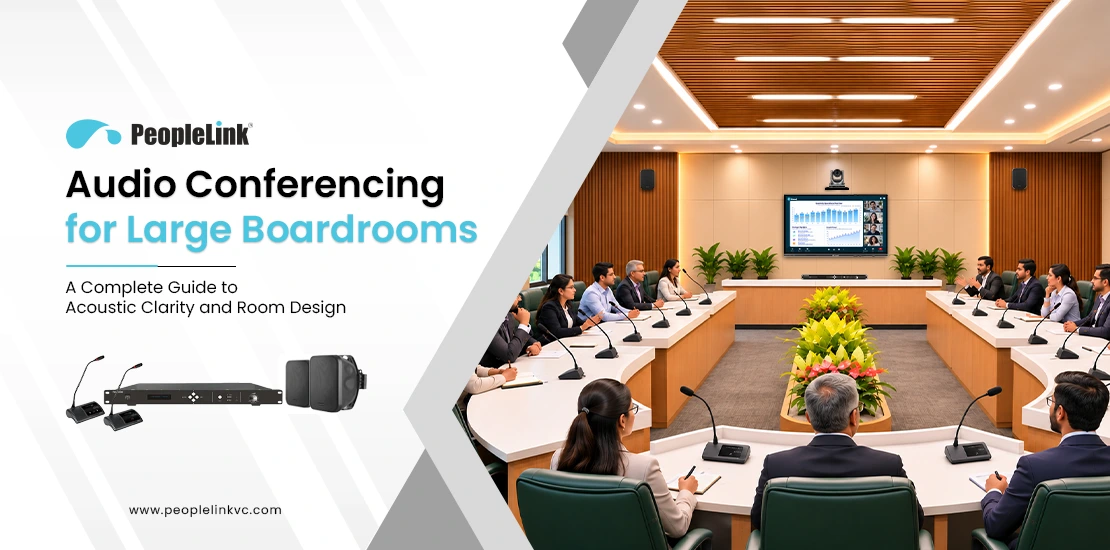
Introduction: The Evolution of Executive Boardrooms
Executive decisions rarely fail for want of ideas; they fail when people can’t hear each other. In the enterprise boardroom the high stakes of a quarterly review or a global M&A discussion are predicated on the ability to have a clear, uninterrupted conversation. The problem is that as boardrooms get bigger and bigger in terms of square footage and number of seats, audio clarity is the most difficult of all the workplace tech challenges to get right.
A single tabletop speakerphone designed for a four person huddle space is simply not going to be able to capture a 25 foot executive table. The old way of doing audio conferences was to have a single omnidirectional mic at a fixed point which meant that the people at the far end of the room were always going to sound very distant, very muffled and often drowned out by the HVAC and the room reverb. Modern audio conferencing for large boardrooms is solved by using a carefully engineered microphone array, dedicated DSP and acoustic tuning so that every seat in the room (and every seat joining remotely) has an equal voice.
Understanding Audio Conferencing in Large Boardrooms
What is a professional boardroom audio conferencing system?
A boardroom audio conferencing system is very different from consumer or small office type peripherals. It’s a full blown multi-component acoustic architecture designed for large rooms with long tables, high ceilings and glass partitions etc. Rather than having a single all in one box you have a combination of distributed capture (ceiling mics, boundary arrays, wired and wireless delegate units), central signal processing, power amplification and a number of loudspeakers all over the room.
Supporting Hybrid Boardroom Solutions
Modern executive meetings are almost entirely hybrid. You’ve got half the leadership team sitting round a physical mahogany table and the other half dialing in from the various regional HQs. Audio is the main conduit between the two groups. If the remote participants are struggling to make out what’s being said off mic or have clipping when two people are speaking at the same time, the collaboration is effectively dead. Full duplex enterprise audio conferencing enables the kind of natural, overlapping conversation you’d expect in a physical meeting without the need to cut anyone off.
Integrating Audio with Video Conferencing
Video grabs the attention but audio is what keeps people engaged. 4K ultra HD video is of no use at all if the audio cuts out or you’ve got terrible echo. Audio is also the key enabler of modern visual automation. The directional voice tracking data from a boardroom mic array can be used to automatically pan and tilt the cameras to keep the active speaker in frame, resulting in a seamless, TV-quality experience for the remote audience.
Common Audio Challenges in Large Boardrooms
Upgrading large conference room audio solutions starts with diagnosing why legacy setups fail in expansive environments:
- Poor microphone coverage: standard mics lose all vocal presence once you’re more than a few feet from the mic. In a 20 to 30 seat boardroom you’re looking at people at the corners being completely outside the pickup radius.
- Echo and background noise: large rooms with glass walls, hard wood tables and bare ceilings will produce a very hollow reverb. Throw in the projector fans, the air conditioning vents and the keyboard typing and you’re very quickly going to be overwhelmed by background noise.
- Uneven voice distribution: if you don’t have the speakers positioned correctly the person sitting right up front on the front display gets absolutely hammered with volume and the people at the back simply can’t hear the remote callers.
- Difficulty hearing distant participants: if an executive leans back in their chair or turns towards a whiteboard then an unamplified mic will drop their vocal level and the remote participants will be forced to ask “could you repeat that please?”
- Compatibility and connectivity bottlenecks: trying to piece together third party mics, mixers and codecs from a range of different vendors invariably results in driver issues, a complete mess of cables across the boardroom table and very slow meeting start times.
Essential Features of an Effective Boardroom Audio Conferencing System
When evaluating professional audio conferencing solutions, IT and AV teams should look for seven foundational capabilities:
- Advanced microphone technology: beamforming array mics and multi-capsule boundary/ceiling units are designed to focus in on the active talker and reject off-axis room noise.
- Noise cancellation and echo suppression: built in acoustic echo cancellation (AEC) to stop the remote voice coming back into the mics. Automatic noise suppression (ANS) will also filter out the steady state HVAC and equipment hum.
- Wide audio pickup coverage: long range 360 degree pickup radii (6 to 10m per unit) to give you full room coverage without anyone having to lean in to the mic.
- High quality distributed speakers (ceiling or wall mounted with dedicated amplification): will give you essentially equal sound pressure levels from the front row right through to the back wall.
- Intelligent Audio Processing (DSP): A dedicated DSP handles the Automatic Gain Control (AGC) to boost the level of the quieter speakers and reduce the level of the louder ones, plus performs smart channel mixing so that any microphones that aren’t in use don’t add in background noise.
- Seamless video platform integration: via native USB Audio Class (UAC) and standard analog or digital interfaces to enable plug and play on UC platforms, room PCs and hardware video conferencing endpoints.
- Scalability across room sizes: via modular expansion ports or multi-channel DSP architectures to allow for the addition of further extension mics or ceiling arrays as the room layout changes.
How to Choose the Right Audio Conferencing Solution for Large Boardrooms
Benefits of Modern Audio Conferencing Solutions
Why Audio Quality Matters in Hybrid Boardroom Meetings
In a hybrid boardroom the acoustic asymmetry very quickly becomes a decision making asymmetry. If the people in the room have absolutely clear, immediate audio to each other and the remote participants are just having to wade through a very muffled, very echoey sound then the remote leaders are going to disengage. They’re not going to jump in, they’re not going to pick up on the context and they’re going to contribute far less to the strategic outcome.
High definition full duplex audio removes that barrier entirely. It ensures vocal parity so that a regional director on the phone from another time zone sounds just as present as the CFO at the head of the table. That in turn enables genuinely inclusive collaboration and much faster consensus.
How PeopleLink Enhances Boardroom Communication
As a single source AV and Unified Communications solution provider PeopleLink deliver complete end-to-end conference room audio systems that are engineered. The mics, signal processors, amps, cameras and displays all work together as a complete system. PeopleLink have purpose built solutions for a range of boardroom sizes, furniture layouts and acoustic profiles across a number of different deployment architectures.
- PeopleLink DSP-CM (Ceiling Microphone System with DSP): Engineered for large conference rooms and boardrooms seating 15 to 30 participants (80 to 100+ sq. meters), the DSP-CM pairs suspended spherical omnidirectional microphones (each offering a 10-meter, 360-degree pickup radius) with a master digital audio receiver. Built-in Acoustic Echo Cancellation (AEC), Automatic Noise Suppression (ANS), and active speaker connectivity keep executive tables completely wire-free.
- PeopleLink CM Alpha (Digital Array Microphone): Ideal for design-led boardrooms, the CM Alpha houses a 7-microphone circular array with adaptive blind beamforming and intelligent voice tracking across an 8-meter, 360-degree pickup radius. It mounts discreetly on the ceiling, wall, or tabletop and connects via plug-and-play USB 2.0 (UAC).
- PeopleLink Pro Audio DSP (12 Channel) & AOE DSP 16×16: For large custom-integrated boardrooms and council chambers, PeopleLink’s multi-channel DSPs deliver full-band adaptive echo cancellation, up to 18dB dynamic noise reduction, smart microphone mixing, and camera-control integration, working seamlessly alongside PeopleLink Wall Mount Speakers and the 200W Amplifier.
- PeopleLink Quad Speakerphone 12 & Quadro: For boardrooms seeking rapid deployment without ceiling installation, the Quad Speakerphone 12 features a 12-microphone beamforming array with a 6-meter pickup radius, 95dB speaker output, USB and Bluetooth connectivity, and support for two extension microphones. Similarly, the PeopleLink Quadro covers 15- to 20-seat boardrooms (30ft x 20ft) with four bi-directional microphones, 92dB speaker output, and optional extension mics.
Because PeopleLink provides both the audio ecosystem and 4K AI and PTZ conferencing cameras under one unified portfolio, IT administrators gain a cohesive, platform-agnostic solution backed by single-vendor support and accountability.
Enterprise Use Case Study: Rebuilding Multi-Room & Boardroom Collaboration for an Engineering Firm
Watch the Case Study Video: How Did PeopleLink Transform Meeting Spaces for an Engineering & Manufacturing Firm?
The Challenge
A large engineering and manufacturing enterprise needed to standardize audio and video quality across multiple executive collaboration spaces, including a 12-seater meeting room, a 20-seater executive boardroom, and a 26-seater conference room. Legacy meeting setups suffered from uneven voice pickup at the far ends of long conference tables and inconsistent hybrid call reliability across rooms.
The PeopleLink Solution
Working with PeopleLink solution specialists, the organization deployed a unified, single-vendor AV architecture tailored to each room’s seating capacity:
- 12-Seater Meeting Room & 20-Seater Boardroom: Equipped with digital array microphones for wide-angle vocal capture, 4K PTZ videobars, and wireless BYOD connectivity for instant meeting starts.
- 26-Seater Large Conference Room: Outfitted with full-room distributed audio and video coverage so every seat receives balanced loudspeaker output and clear microphone pickup.
The Outcome
- Uniform Full-Room Audio Clarity: Executives seated anywhere along the 20- and 26-seat tables communicate naturally with remote teams without vocal drop-offs.
- Clutter-Free Executive Tables: Overhead digital array microphones and wireless BYOD presentation tools eliminated table cable clutter.
- Single-Vendor Accountability: Standardizing hardware and software under PeopleLink simplified IT management and ongoing support across every collaboration room.
Conclusion
Investing in dedicated audio conferencing for large boardrooms is no longer an optional AV upgrade; it is core infrastructure for modern enterprise leadership. When executive rooms are equipped with wide-coverage microphone arrays, intelligent echo and noise processing, and balanced speaker distribution, every meeting becomes clearer, faster, and more inclusive.
With a comprehensive portfolio spanning ceiling microphones, multi-channel DSPs, expandable boardroom speakerphones, and integrated video endpoints, PeopleLink serves as a trusted technology partner for enterprises building future-ready boardrooms.
Ready to Upgrade Your Boardroom Audio Experience?
Eliminate echo, dead zones, and hybrid meeting friction with a tailored AV architecture from PeopleLink. Connect with our enterprise solution specialists to design the ideal setup for your boardroom dimensions and collaboration workflow: Contact PeopleLink Today.
1. What is the best microphone setup for a large boardroom?
For large boardrooms seating 15 to 30+ people, ceiling-mounted array microphones (such as the PeopleLink DSP-CM or CM Alpha) or multi-microphone tabletop systems with extension pods provide the most consistent coverage. Ceiling microphones keep tables completely clutter-free while capturing voices evenly across a 360-degree radius.
2. Why is a Digital Signal Processor (DSP) important in large conference room audio solutions?
A DSP acts as the acoustic brain of the room. It performs Acoustic Echo Cancellation (AEC), suppresses continuous HVAC and projector noise, balances volume differences between quiet and loud speakers via Automatic Gain Control (AGC), and automatically activates only the microphone channel nearest to the active talker.
3. How do I eliminate echo in a glass-walled boardroom?
Glass and hard surfaces reflect sound waves and cause reverberation. To eliminate echo, combine directional beamforming microphones that focus strictly on speakers’ voices with a DSP featuring full-band Acoustic Echo Cancellation (AEC) and reverberation suppression, alongside evenly distributed speakers running at moderate volume.
4. Can we upgrade our boardroom audio without drilling into the ceiling or table?
Yes. Wireless and USB expandable speakerphones, such as the PeopleLink Quad Speakerphone 12, feature built-in 12-microphone arrays, 6-meter pickup radii, rechargeable batteries, and optional extension microphones, enabling full-room coverage with zero structural modifications.
5. How many microphones are needed for a 20- to 30-seat boardroom?
Depending on the room’s length and acoustics, a 20- to 30-seat boardroom typically requires either two suspended ceiling microphones (each covering a 10-meter radius) or a multi-channel DSP setup with 6 to 8 boundary or tabletop microphones so every participant remains within 2 to 3 meters of a pickup element.
6. Are PeopleLink boardroom audio conferencing systems compatible with existing video conferencing platforms?
Yes. PeopleLink audio devices use standard USB Audio Class (UAC) interfaces, Bluetooth, and balanced analog and digital connections, ensuring plug-and-play compatibility across Windows, macOS, hardware video conferencing codecs, and all major unified communications platforms.