

Video Conferencing Requirements Checklist: Everything You Need for a Professional Setup
- September 30, 2021
- Posted by: Damanjeet Kaur
- Categories: Blogs, Video-Collab
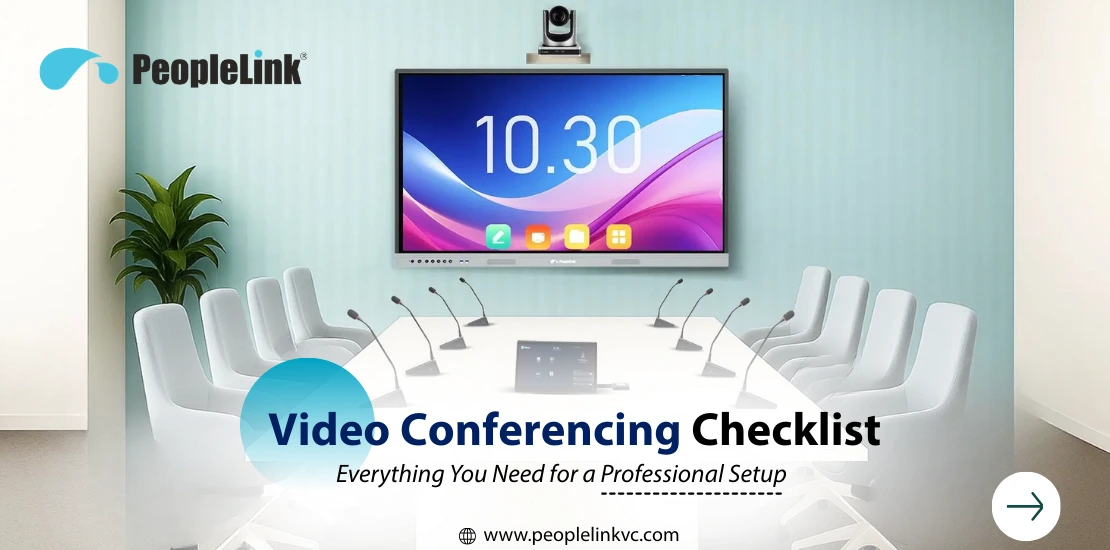
Quick answer: Audio is the part of a video call people forgive least, so clear capture and playback matter more than any other single factor. In rooms, beamforming microphones and tuned speakers handle distance and reverberation that built-in laptop mics cannot. PeopleLink engineers microphones, speakerphones, and DSP audio as part of one conferencing platform.
In the modern business landscape, the quality of your digital presence is often just as important as the quality of your physical office. Whether you are closing a high stakes deal with a global partner or brainstorming with a remote team, video conferencing has become the primary bridge for collaboration. However, we have all experienced the frustration of a subpar meeting: grainy video, echoing audio, and the dreaded “can you hear me now?” interruptions. These technical hiccups do more than just waste time; they erode professional credibility and stall productivity. To achieve a seamless, broadcast-quality experience, you need more than just a laptop and an internet connection. This comprehensive guide breaks down the essential video conferencing requirements into a practical checklist, ensuring your setup is professional, reliable, and ready for the future of work.
Fixing room audio? Explore PeopleLink’s audio conferencing devices tuned to hold clarity across the whole table.
1. The Core Engine: Processing and Codecs
Before you look at cameras or microphones, you must consider the brain of your setup. In video conferencing, this involves the Codec (Coder-Decoder) and the Processing Power of your machine.
The Codec: Heart of the System
A codec is the technology that compresses your outgoing audio and video signals to send them over the internet and decompresses the incoming signals from your participants. There are three primary ways to handle this:
- Hardware Endpoints: Dedicated devices designed specifically for video conferencing. These are ideal for permanent boardrooms where reliability is paramount.
- Software-Based Systems: Applications installed on a PC or Mac. This is the most common choice for hybrid workers and small businesses.
- WebRTC (Browser-based): No download solutions that run directly in browsers like Chrome or Firefox. These are excellent for guest invitations and quick, ad-hoc meetings.
Computing Power
Video processing is resource-intensive. For a smooth experience especially if you plan to share screens or use virtual backgrounds, ensure your computer meets these minimum specs:
- Processor: Quad-core (i5 or equivalent) at a minimum. For 4K video or multi-monitor setups, an i7 or M-series chip is recommended.
- RAM: At least 8GB (though 16GB is the modern standard for multitasking).
- Operating System: Ensure your OS is updated to support the latest security patches of your conferencing software.
2. Visual Excellence: Camera and Display
Non verbal communication, eye contact, facial expressions, and gestures account for a significant portion of human interaction. High-quality visuals are essential to maintaining that connection.
Choosing the Right Camera
The built-in webcam on most laptops often struggles with low light and fixed focal lengths. Consider these upgrades:
- Standard Webcams: Look for 1080p (Full HD) at 30 or 60 frames per second (fps).
- PTZ (Pan-Tilt-Zoom) Cameras: For conference rooms, a PTZ camera allows you to frame multiple people or zoom in on a whiteboard without losing image quality.
- Field of View (FOV): A 70 to 90 degree FOV is perfect for individuals. For large rooms, you may need a wider angle or an AI-powered camera that follows the speaker.
The Display Setup
Seeing your colleagues clearly is just as vital as being seen.
- Size Matters: In a huddle room or home office, a 24 to 32 inch monitor works well. For boardrooms, consider dual 55-inch+ screens: one for the participants and one for shared content.
- Placement: Mount your display at eye level. This encourages you to look toward the camera, simulating natural eye contact.
3. The Sound of Success: Audio Essentials
A meeting can survive a brief video freeze, but it cannot survive poor audio. If participants can’t hear you clearly, the meeting is effectively over.
Microphones
- Personal Use: A high-quality USB condenser microphone or a professional-grade headset with a noise cancelling boom mic.
- Conference Rooms: Boundary microphones or puck style speakerphones that offer 360-degree pickup. For larger rooms, ceiling-mounted mic arrays are the gold standard.
Speakers and DSP
- Acoustic Echo Cancellation (AEC): Ensure your hardware includes AEC to prevent your speakers’ output from being looped back into your microphone.
- Digital Signal Processors (DSP): In complex setups, a DSP unit balances audio levels, removes background hum (like AC units), and ensures crystal-clear output.
4. Networking and Internet Fundamentals
The most expensive hardware in the world will fail on a weak network. Stability is the name of the game here.
Bandwidth Requirements
While 1 to 2 Mbps might work for a basic call, professional standards require more:
- HD Video (720p): 2.0 Mbps up/down.
- Full HD (1080p): 4.0 Mbps up/down.
- Group Calls (5+ people): 6.0 Mbps+ recommended.
Connection Stability
- Hardwired is Best: Whenever possible, use an Ethernet cable. Wi-Fi is prone to interference and signal drops as other devices join the network.
- Symmetrical Speeds: Most home internet plans prioritise download over upload. For video conferencing, your upload speed is what determines how you look and sound to others. Test your connection by doing a WiFi speed test and ensure your plan offers a high upload ceiling.
5. Environmental Engineering: Lighting and Acoustics
You can have a 4K camera, but if you are sitting in a dark room with an echo, you won’t look or sound professional.
Lighting Techniques
- The Golden Rule: Light should be in front of you, not behind you. If there is a window behind you, you will appear as a dark silhouette.
- Soft Lighting: Avoid harsh overhead lights. Use a ring light or desk lamp with a diffuser to fill in shadows on your face.
Background and Aesthetics
- Clutter-Free: A clean, professional background (bookshelves, a solid wall, or a branded office backdrop) minimises distractions.
- Colour Palette: Solid, neutral colours like blues or greys work best for cameras. Avoid busy patterns that can cause visual flickering on low-bandwidth connections.
Room Acoustics
- Dampen the Echo: Hard surfaces (glass, tile, bare walls) reflect sound. Add soft elements like rugs, curtains, or acoustic foam panels to absorb sound and make your voice sound richer.
Future-Ready Collaboration: Our Latest Solution for 2026
To see these principles in action, take a look at our recently launched video conferencing solution. This video showcases how we are helping our customers build “2030-ready” meeting rooms today. By integrating a fully synchronized AV ecosystem, featuring AI-powered speaker tracking, 4K interactive displays, and smart digital podiums, we eliminate the common technical frustrations mentioned in this guide. This unified advantage ensures that your hardware, software, and room controls work as one seamless unit to maximize collaboration and professional clarity.
6. Video Conferencing Requirements: Quick Checklist
| Category | Requirement | Pro Tip |
|---|---|---|
| Hardware | Quad-core CPU, 8GB+ RAM | Close unnecessary apps to free up CPU. |
| Video | 1080p Webcam or PTZ Camera | Clean your lens with a microfiber cloth weekly. |
| Audio | Noise-canceling Mic + AEC Speakers | Use a Mute shortcut for better meeting etiquette. |
| Internet | 4 Mbps+ (Symmetrical) | Use Ethernet instead of 2.4GHz Wi-Fi. |
| Lighting | Front-facing, soft light source | Avoid windows directly behind you. |
| Environment | Neutral background & sound absorption | Add a rug to small rooms to stop echoes. |
7. Use Case Scenarios
The Hybrid Professional (Home Office)
- Setup: 1080p USB webcam, USB headset or dedicated desk mic, and a simple ring light.
- Priority: Eliminating household background noise and ensuring a professional backdrop.
The Huddle Room (3 to 5 People)
- Setup: A wide-angle (120° FOV) All-in-One video bar that combines camera, mic, and speaker.
- Priority: Ensuring everyone at the table is visible without crowding.
The Executive Boardroom (10+ People)
- Setup: Dual displays, PTZ camera with auto-tracking, and integrated ceiling microphone arrays.
- Priority: Intelligent audio pickup and seamless integration with room control systems.
Conclusion
Setting up a professional video conferencing environment is an investment in your communication and your brand. By ticking off the boxes for high-quality codecs, reliable processing, clear optics, and stable networking, you remove the barriers between you and your audience. Remember, technology should be the invisible facilitator of your ideas. When your setup is optimized according to this checklist, you stop worrying about the how of the meeting and start focusing on the what the collaboration, the connection, and the results.

Frequently Asked Questions
Why does meeting room audio sound poor?
Poor room audio usually comes from microphones placed too far from speakers, hard surfaces that cause echo, and devices not tuned for the room. Beamforming microphones and digital signal processing correct for distance and reverberation. PeopleLink supplies room audio matched to space size.
What microphone is best for a conference room?
For most conference rooms, a ceiling or table beamforming microphone array gives even pickup so everyone is heard without leaning in. The right count depends on room size and seating. PeopleLink offers ceiling, table, and array microphones for different layouts.
Can I add good audio to a room that already has a camera?
Yes. Audio can be upgraded on its own, but the best results come from matching microphones, speakers, and the camera as one tuned system. PeopleLink audio is designed to integrate with its cameras and room endpoints.
Ready to upgrade your rooms?
See PeopleLink’s AV and Unified Communications solutions in action, or get pricing built around your needs.