

CIO Review Award
- October 14, 2025
- Posted by: Arti Sharma
- Category: Awards
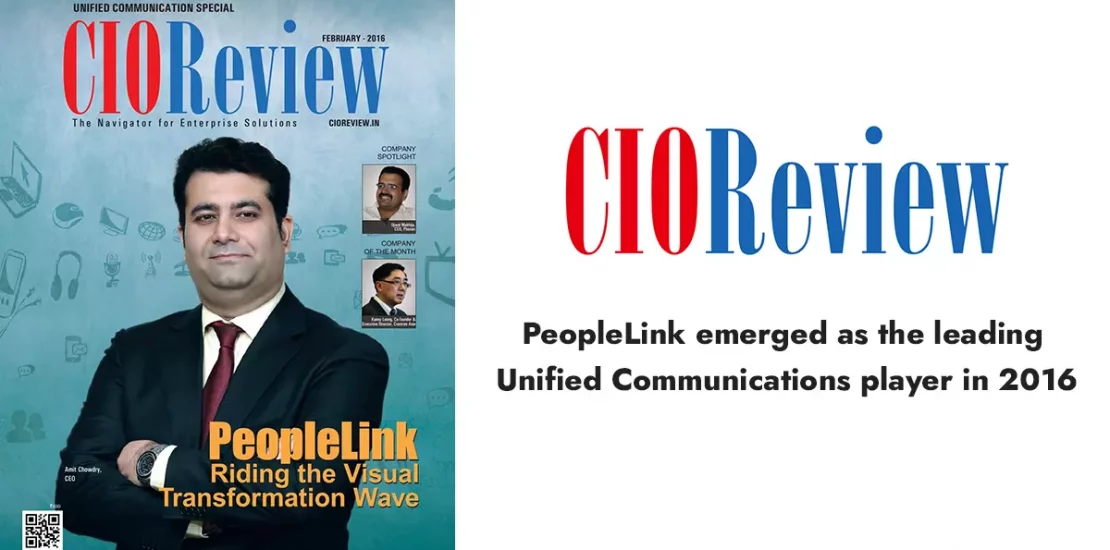
PeopleLink emerged as a leading Unified Communications player in 2016 and was featured on the cover of CIOReview magazine that year.
Unified communications was still a buzzword for many organisations in 2016. The companies that understood it early treated it not as a single app, but as the discipline of making voice, video, content, and rooms work together. That is the thread PeopleLink has followed since.
What Unified Communications Actually Means
Unified communications brings an organisation’s video, audio, content sharing, and messaging together so people can collaborate consistently across devices and locations. In a room, it means the camera, audio, display, and software act as one system rather than four separate purchases.
PeopleLink’s video conferencing solutions are built on that principle, which is why a meeting behaves the same whether someone joins from a boardroom, a desk, or a phone.
Consolidation Is the Real Value
The biggest gain from unified communications is consolidation. Instead of one vendor for cameras, another for audio, and a third for room systems, an organisation runs a single, supported stack. PeopleLink delivers this as one OEM, which means aligned firmware, one support path, and a standard build the IT team can repeat.
Consolidation also makes the estate easier to reason about: fewer moving parts, fewer integration gaps, and a clearer upgrade path as needs grow.
From 2016 to a Distributed-Work World
What looked forward-thinking in 2016 is now table stakes. Distributed teams expect to meet across locations without friction, and the rooms that deliver that are the ones built as unified systems. PeopleLink’s room endpoints carry that same idea into today’s hybrid workplace.
Common Pitfalls When Adopting Unified Communications
The first pitfall is buying tools instead of a platform: a camera here, an audio device there, a room system somewhere else, with no single owner when they fail to cooperate. The second is ignoring the room itself, assuming software alone will fix poor audio or framing. The third is skipping standardisation, so every room becomes a one-off that the IT team has to relearn.
Each of these is avoidable by treating unified communications as one integrated system from the start. PeopleLink delivers that as a single OEM, which is why its video conferencing solutions behave the same way in every room and stay supportable as the estate grows.
Matching the Room to the Meeting
Unified communications only feels unified when the room fits the meeting. A two-person huddle space needs a compact camera and a single speakerphone; a boardroom needs a wider or tracking camera and a microphone array that reaches the whole table; an auditorium needs a PTZ camera with optical zoom and ceiling audio.
Getting this wrong is the most common reason a video deployment disappoints: the technology is fine, but it was sized for the wrong space. PeopleLink’s approach is to match the build to each room type and run them all on one platform, so the experience holds whatever the room.
That room-by-room discipline, applied consistently across an estate, is what turns unified communications from a slogan into something employees actually rely on.
Frequently Asked Questions
What is unified communications?
It is the integration of an organisation’s video, audio, content sharing, and messaging so people collaborate consistently across devices and locations. In a room it means the camera, audio, display, and software work as one system.
Why does unified communications matter for a business?
It removes friction from meeting across locations, speeds decisions, and reduces support overhead by consolidating onto one supported stack instead of many separate tools.
How does PeopleLink deliver unified communications?
As a single OEM that designs, assembles and manufactures the hardware and builds the software, so rooms are standardised, updated as one platform, and supported through one path.
Ready to talk to PeopleLink?
See PeopleLink’s AV and Unified Communications solutions in action, or get pricing built around your needs.